Inspired by Elin Kelsey’s picture book Not Your Typical Book About the Environment, I share with you some inspiring actions and unique inventions sure to put a smile on your face. (If, like my daughter, you are just interested in the poop part, please scroll down 
Who knew thinking green could be so fun and trendy? Perhaps you or your child might come up with the next innovative earth-saving idea.
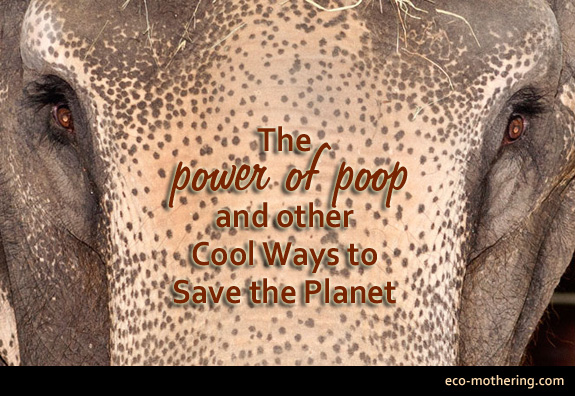
Asian elephant “Kimbo” from the Denver Zoo.
FASHION FORWARD
- Mom, can I eat my seat, please? Rohner Textil AG, a Swiss fabric company once facing bankruptcy due to the high cost of disposing of its toxic waste, re-engineered its product to create fabrics so clean, they’re edible. Some Lufthansa airplanes now use this fabric on their seat covers. I wonder if they taste better than the peanuts…
- In the drive to develop more eco-friendly fashion, American scientists are experimenting with producing fabrics from farm byproducts like chicken feathers and rice straw. Some other strange but true materials making their way into the fashion industry include tree bark, bananas, seaweed, coffee grounds and cigarette butts.
- Tesco, a British supermarket chain, joined forces with a fashion label to create a line of clothing from the supermarket’s waste, including food packaging, plastic bags and meat trays.
- Nike’s Reuse-A-Shoe program collects old sneakers (any brand) and recycles the materials into soccer and football fields (rubber), tennis courts (foam) and the padding beneath basketball floors (fabric).
TECHIE TRENDS

- How about a James Bond-style cell phone? Today’s eco-conscious designers focus on a process called active disassembly in which products are designed to break apart easily when exposed to heat or magnetism at the end of their life cycle. Product materials are then easily recovered for reuse or recycling. Following this philosophy, Nokia made a cell phone prototype that deconstructs in two seconds from the blast of a laser beam.
- The European Union requires all businesses that manufacture WEEE (Waste Electrical and Electronic Equipment) to be responsible for recovering and recycling their products (no more shipping them off to third-world countries). This has created a huge career market for Green IT, an area our computer-savvy kids should do really well in.
- Rotterdam, the Netherlands, is home to Club WATT (now closed) where the energy of the dancers was transformed into electricity for the dance floor light show. WATT was just one example of a large-scale energy floor installation from Sustainable Dance Club, an effort dedicated to taking responsibility for our planet while having fun.
GARDEN GROWTH

- Urban farming has exploded in popularity in cities across the world. Aside from providing local food, rooftop gardens reduce carbon dioxide and other greenhouse gases, insulate buildings and soak up stormwater runoff. The vertical farm is the next big thing. Researchers and designers are developing prototypes of skyscraper farms. Just one 30-story farm could grow enough food to feed 50,000 people a year!
- The Lifestraw® portable water filter allows people in impoverished countries to safely drink from their local water resources, even a muddy puddle.
- Seed bombs allow guerilla gardeners to create greenspace in every concrete nook and cranny. Although the idea is not new, it has recently regained popularity, and bombers everywhere are transforming urban wastelands into vegetative sites. Learn to make your own seed bombs.
POOP POWER
Under the gentler moniker of ‘bio-gas,’ businesses around the globe are seeking ways to harness the power of human waste, which contains bacteria that releases methane gas.
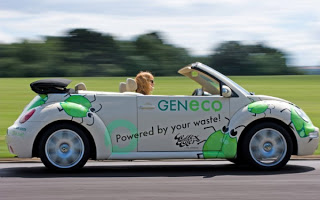
- Using solid waste from 70 homes, British company GENeco powered a VW Bug (the Bio-Bug) to run 10,000 miles per year.
- POOPOOPAPER™ uses animal dung to create their collection of notepads, journals and paper ornaments. You can even shop by poop type (elephant, panda or moose?).
- The Swiss trap the methane from their sewage plants to make bio-gas for powering city buses and heating homes. Human poop powers streetlights and cooking gas in parts of India.
- Using its own gasification technology, by 2013 the Denver Zoo’s newly refurbished “Elephant Passage” will convert more than 90% of its waste into sustainable energy. It used that same technology to introduce the world’s first poo-powered motorized rickshaw earlier this spring.
FUN TIDBITS
- Bug Power What if we had to pay for the free labor that insects provide (pest control, pollination, waste decomposition, wildlife food)? Ecological economists recently determined the value of bug labor would be more than 57.3 billion dollars!
- More than 25% of Stockholm’s city buses run on alcohol confiscated at the border. This is only one of many creative ways that Sweden is making good on its pledge to become the first oil-free country by 2020.