


My husband and I seem to be one of the few parents I know who do not use time-outs in their discipline. For us, time-outs feel too punitive, a display of power where the parent “wins” but the child doesn’t necessarily learn anything about amending his behavior.
I think it began in pregnancy when I stumbled upon the eight principles of attachment parenting. In theory, the “Respond with Sensitivity” principle spoke to me as the respectful way I wanted to raise our daughter. In practice, it was a lot harder to maintain in high-stress situations. But it worked well through the typically tough toddler years and remains an excellent guideline for our parenting.
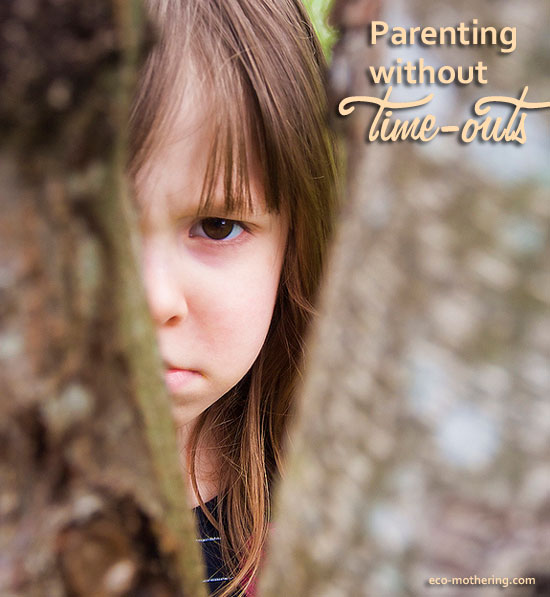
Holding Sofie, hugging her, speaking to her calmly, trying to understand the needs behind her behavior… all contributed to relatively few toddler tantrums and a sense of safety where she can now express her seven-year-old feelings and needs. Often, we do find it better to take some space when an emotional situation arises—Sofie often does this herself until she calms down, but it is not doled out as a punishment.
The problem I have with time-outs is that they send your child away at a time when she likely needs you most. To the child’s immature mind, such action compounds the feeling that they are “bad.” Generally, a young child has acted out because it’s developmentally appropriate to do so. Unaccustomed to strong feelings, they are exploring ways to handle them; they are testing their independence, their safety, your love. They are not acting out of intentional mean-spiritedness that we often associate with hitting, biting, throwing and screaming.
Fear-Based Parenting
Childhood educator and communication expert Sarah MacLaughlin says it better than me when she associates time-outs with fear-based parenting.
“We yell at the four year-old to pull it together, or we separate him in a time-out until he can behave better. Both yelling and time-out are fear-based punishments—the former creates fear of a parent’s anger and the latter brings fear of the withdrawal of a parent’s attention, closeness, and love. (Ironically, a child who has lost control of their emotions and behavior will regulate much more quickly and efficiently with a calm adult near them, rather than being sent away and isolated.)”
“Punishments of any kind are fear based, and often consequences are just thinly veiled punishments. Don’t we want children to be intrinsically motivated to behave well, to have understanding of why they are being guided to behave in certain ways and not in others? Children who are motivated by fear learn to be sneaky to avoid punishment. When we use fear, the ultimate goal of discipline ‘to teach’ is completely lost.”
Sarah’s book, What Not to Say: Tools for Talking With Young Children, guides parents through communication struggles with children ages one through six.
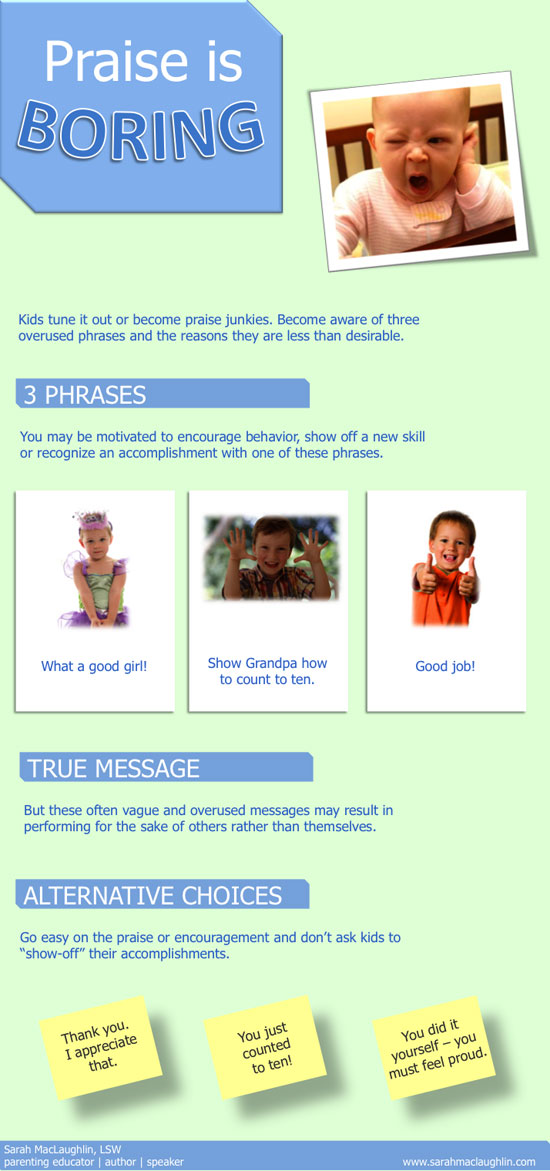
I agree with a lot of what Sarah has to say—although I am not always able to follow through on it. Too many times I’ve lost my cool or said, “Good job!” in a distracted manner rather than really observing what Sofie is sharing with me… Because too much praise is also a parenting no-no. This book will tell you why and offer alternative words for you. See Sarah’s infographic below for a few examples.
Resources for Parents

I wish I’d had this book from the beginning. What Not to Say is an award-winning resource for your parenting toolbox that will help you think twice about knee-jerk responses and steer you toward words that offer your child empathy instead of guilt.
 You can get Sarah’s book as part of a mini eBook collection from my affiliate partner, Mindful Nurturing. The collection, entitled Parenting the Early Years, is just $19.97 and also includes: The Colic Solution, Twin Manibreasto, Oxytocin Parenting—Womb Through the Terrible Twos, The Natural Parent’s Guide to Babywearing, and a one-year subscription to Juno, a natural family magazine. That’s a retail value of $67 – yours for only $19.97.
Parenting isn’t taught in school, and doesn’t always come naturally to us. What a relief to be able to rely on resources from experts who can help us navigate these emotional waters of early childhood!
Get 5 Parenting Books and 1 Magazine for $19.97!
Click here to visit Mindful Nurturing for product details. Scroll down to click on “The Early Years” and read about the six included items. You can buy the Early Years mini collection from that page or through the link below.

Interested in More?
Parenting the Early Years is part of the Essential Parenting Collection, which consists of four more mini collections: Mindful Guidance, Child Development, Resources for Parents, and Pregnancy and Birth. Visit Mindful Nurturing to get information about one of these other eBook bundles or to preview the full collection (a $751 value for $49.97).
Photo credit: roseannadana via photopin cc.
This post has been shared on Natural Family Today and Natural Living Monday.




















Pingback: Natural Family Friday 4/11/14 | Natural Family Today