


Many of us reach for the allergy medication during hay fever season, but we think twice before giving it to our kids. Here are some natural allergy remedies you’ll feel comfortable trying on your little ones.

Photo: Jin Suk/Flickr
-
Local Honey
This is a much-discussed remedy that has worked well for my family. The theory is that ingesting honey from local plants and flowers builds up your immune system to those same plants, sort of like a vaccine. I’ve used it myself before, and this year we tried it on Sofie when she began to exhibit signs of hay fever: sneezing and stuffy nose.
You usually have to plan ahead for this and begin taking 1 teaspoon of locally grown honey about 4-6 weeks before allergy season. Typically, I have used commercial honey common in the stores or honey direct from a friend’s hive, but raw honey is supposed to be your best bet. It doesn’t look as clean and clear, but it contains much higher proportions of nutritional elements.
-
Mint Tea
I’d recently read about peppermint tea counteracting allergies, so we decided to try this method as well. Especially since Sofie decided after a few weeks that she didn’t like eating a spoonful of plain honey every day. Now I mix it into a cup of hot tea in the evening and she’s been downing that like nobody’s business. I have to say that her allergy symptoms have practically disappeared over the last month.
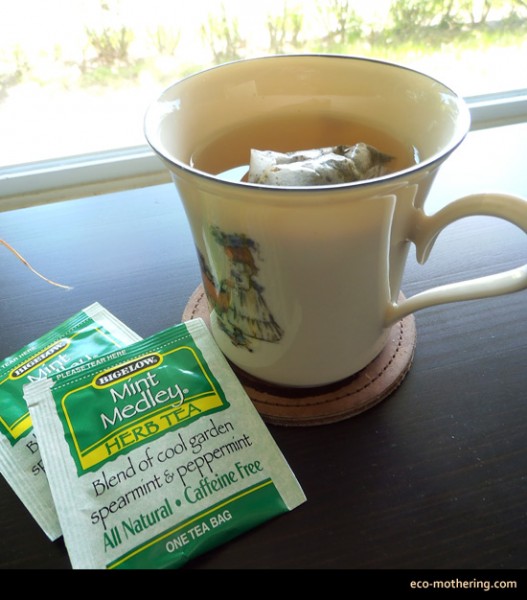
Peppermint has decongestant and anti-inflammatory properties and makes a yummy cup of tea. However, I did read that peppermint tea should be used with caution in very young children as it may aggravate GERD (gastroesophageal reflux disease) or cause a choking sensation due to the menthol. Spearmint is a better alternative. We’ve been using Bigelow Mint Medley— a combination of peppermint and spearmint tea. -
Water (drinking, washing and rinsing)
This is perhaps the easiest and cheapest remedy, and works well alongside other remedies. Drinking water helps thin nasal mucus in stuffy noses. Washing your child’s face (and changing their clothes) after they’ve been outside keeps them pollen free. A shower before bed would be best, but I’ve found that even just rinsing Sofie’s face and eyes with cool water helps keep allergies at bay.
Studies have shown the neti pot to be most effective in reducing allergies, but it’s a strange sensation for kids to get used to. Based in Ayurvedic traditions from India, the neti pot is a small container (shaped rather like Aladdin’s lamp) that you use to flush your nostrils with saline water. It rinses away those bits of pollen and even helps with sinus problems. You can find them online or at nearly any drugstore these days. For best results, use the neti pot twice a day, at morning and night. And you don’t have to keep buying those premade saline packets. Make your own by mixing ½ teaspoon of salt with pinch of baking soda in eight ounces of warm water.
-
Quercetin
A plant-derived compound, quercetin is a natural antioxidant that keeps cells from releasing histamine. Now I took quercetin supplements a few years back and didn’t find them very helpful, but I’ve since read that it works well in correlation with another natural remedies. For adults, the recommended dosage is 1,000 mg/day, and it’s best to begin taking it six weeks before allergy season. Note: Quercetin supplements are not recommended for kids as not enough research has been done on possible side effects.
However, you can give your kids foods with high levels of natural quercetin: apples, grapes, citrus fruits, dark berries, onions, tomatoes, broccoli and leafy greens. Just one more reason to have your kids munching on healthy fruits and veggies. (Speaking of fruits, those allergic to ragweed should avoid melons, cucumbers and bananas during allergy season).
-
Omega-3 Fatty Acids
Studies have shown that people who eat foods rich in anti-inflammatory omega-3s have less allergy symptoms. I haven’t tried this method yet, but since omega-3s are good for so many things, it wouldn’t hurt to beef up Sofie’s intake of them. Omega-3 fatty acids are prevalent in cold-water fish (salmon, haddock and cod), walnuts, grass-fed beef, eggs and flax seed.

Note: I do most of my shopping at Vitacost.com, where you can find some of these items for discounted prices. First-time users, if you use my affiliate link through the ad below, we will each save money on our orders. Thanks 

This post is featured on Frugal Days, Sustainable Ways, Party Wave Wednesday and Small Footprint Fridays.




















Honey is a big one that we use here!