


I had this idea to incorporate regular Top 5 lists into my blog posts, as people seem to love information condensed like that. Sofie wanted me to begin with animals. Coming off the heels of her Save The Wild Animals birthday party last weekend, it seemed fitting.
According to Defenders of Wildlife, there are more than 1800 plant and animal species currently protected by the Endangered Species Act. One of the biggest factors threatening these animals is habitat loss due to pollution or development.
My top 5 below are found in America and are not necessarily the most threatened. They are just five species that Sofie and her friends showed an interest in learning about. I’ve included links on protecting them—kids enjoy knowing they have the power to help animals in need.
- Jaguar. Not your typical kitty, the jaguar is the largest cat in the Americas. The tail alone can reach 30 inches. Adults grow to about three feet in height and four feet in body length. Ranging from southern United States to South America, jaguars are mainly forest dwellers, but they also swim and hunt in the water. (See this National Geographic video of a jaguar vs. a croc.) The species was hunted for its spotted coat in the 1960s and 1970s. Today, their numbers decline largely due to clearing of the rain forests and, less so, because some farmers and ranchers kill the cat for eating their livestock. Save the jaguar.
- Sea Turtle. One of the planet’s oldest creatures, the sea turtle species has been around since the dinosaurs! Unlike other turtles, this marine creature cannot retract its head into its shell. Sea turtles migrate hundreds of miles in temperate waters between feeding and nesting grounds, and they can live up to 80 years old. Kemp’s Ridley is the smallest sea turtle (30 inches) and the leatherback is the largest (six feet). Only about 1 in 1,000 baby sea turtles survive due to predators, development and human pollution such as oil spills and marine debris, which the animals ingest or become entangled in. Read 5 things you can do to save sea turtles (including turning out the lights)!
- Gray Wolf. Great grandpa to the domestic dog, wolves are the largest member of the canine family and can sprint up to 45 mph. Although called “gray,” they range in color from white to brown to black and are mostly found in the northern United States and Canada. (Yellowstone National Park is a great place to see and hear wolves in their natural habitat.) Nearly wiped out in the U.S. in the 1930s, wolves are making a comeback. Their biggest threats are human development into wolf territory and being targeted by livestock owners. Help organizations protect this species by adopting a gray wolf.
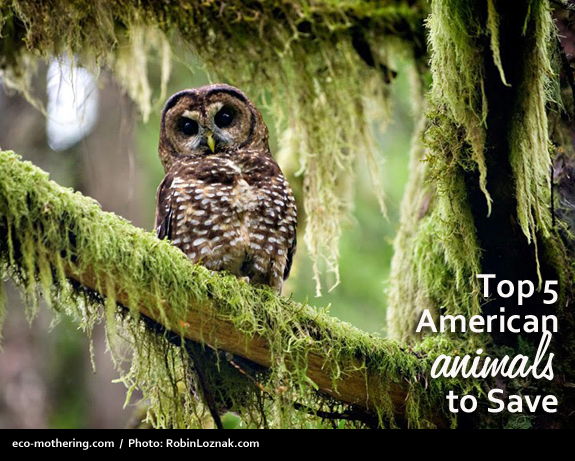
- Northern Spotted Owl. The disappearing old growth forest is this creature’s biggest problem. Northern spotted owls pair off and require a sizeable area for nesting and hunting, however, their habitat within America’s oldest forests (mostly in the Pacific Northwest, California and British Columbia) is targeted by loggers for the massive, old-growth trees. Like other owls, the northern spotted owl hunts at night for flying squirrels and mice, silently swooping down on its prey with a four-foot-long wingspan. Sign this petition to protect the northern spotted owl. / Read my article published in Skipping Stones children’s magazine on the plight of the spotted owl.
- North Atlantic Right Whale. One of the rarest marine mammal species, the North Atlantic right whale (called that because it was once considered the “right” whale to hunt) has less than 400 individuals left in the world. These peaceful giants can weigh up to 70 tons, average 50 feet in length and are usually found on the eastern coast from Nova Scotia to Florida. This whale can be distinguished by its lack of a dorsal fin and the white patches of skin (callosities) on its unusually large head. Humans pose the biggest threat – at least four North Atlantic right whales were killed last year due to injuries sustained from entanglement in fishing gear and being hit by a ship. Have your kids play the Right Whale Identification Game sponsored by New England Aquarium, or learn what you can do to protect this species from extinction.
PAID ENDORSEMENT DISCLOSURE: In order for me to support my blogging activities, I may receive monetary compensation or other types of remuneration for my endorsement, recommendation, testimonial and/or link to any products or services from this blog.




















Thanks very nice blog!
Here is my web site : energy