


Sofie’s been going through a phase where she no longer likes to hike. (At least, I hope it’s a phase.) How did this happen? I have blogged here for nearly two years about my nature girl and our outdoor exploits around New England. Now she doesn’t even want to take evening walks in our neighborhood – would rather be carried or pushed in the stroller.
Then a few Sundays ago, we finally joined Rhode Island Families in Nature on one of their monthly hikes. This one was through Ryan Park in North Kingstown – a place we’d never been — and Sofie actually seemed to enjoy herself. She walked about two-thirds of the trail herself. It must have been the other kids. Group behavior. Seeing other little ones hiking and having fun zapped the whining right out of her. That, and stopping for a mug of hot chocolate afterwards. She said she’d hike again if it meant hot cocoa afterwards!
My three-year-old has also been displaying an inquisitive nature recently. Her latest issue is about bugs. When we had that warm spell recently, she noticed the flurry of moths that congregated outside our windows and doors in the evening. Now she notices their absence and asked me: “Where do the bugs go when it gets cold?” I had to tell her I honestly didn’t know…
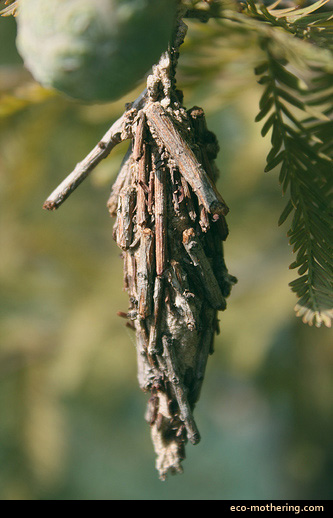
Bagworm cocoon by Justin D. Miller/Flickr
But after a bit of reseach, I can now tell her that some insects (like the monarch butterfly) migrate south seeking warmer temperatures. Most bugs will stay here, finding some sort of shelter in hollow trees, caves, crevices or even below the icy ponds (mosquitoes and dragonflies).
Some will actually dwell in human houses. Ladybugs, flies and some beetles overwinter in attics, wall voids and other out-of-the-way areas in our homes (this I think I will not tell her). Others (such as cicadas) will spend winter underground in larvae form. And the moth that started this line of questioning? They cocoon in the fall and need that cold winter to fully develop. If they hatch early, chances are they don’t survive. So I suppose I will have to inform Sofie that those moths of a week ago have probably since died.
On a holiday note, we’ve switched to LED lights this year, for the tree and outside. In case you needed some incentive to make the switch, LEDs offer several bonuses:
- Added safety. Lamps always remain cool to the touch. Because holiday lighting is often used in close proximately to combustible materials (dry evergreen trees) this feature can greatly reduce the risk of holiday fires.
- Solid-state reliability. No longer will you have to worry about one lamp ruining your whole string.
- Longevity. LED lamps are rated for 50,000 hours of use or more while standard incandescent lights typically last for only 2,000 hours.
- No glass bulbs to break. LED lights are encased in a nearly indestructible epoxy casing
- No filaments to burn out. Unlike incandescent bulbs there is not filament to burn out so they last much longer and won’t be damaged or ruined if you drop them or step on them.
- Extreme energy efficiency. Uses only 10% of the electricity required to power traditional incandescent. For a typical household this will mean a cost savings of $20.00 or more during the standard 30 day holiday season.
- Nearly indestructible, solid epoxy lenses. High-quality LED lights can withstand the force of a tractor trailer without breaking.
- Rust proof, Zinc-coated lamp contacts. The lamp components will not rust when used outdoors or in moist environments.
- Uses standard house current (120 VAC, 60 Hz). No need for an electrician or expensive power converters.
- No transformer required. Allows for simple installation and use.
And there is a light recycling program for those old holiday incandescents. Do it now and you’ll receive a coupon for buying those LEDs!























Great Blog! New blog on the Hx.of the Ladybug:
http://historyoftheladybug.blogspot.com/
This comment has been removed by a blog administrator.