


My husband and I have lived with pets off and on for 12 years. These included 1 cat, 2 guinea pigs and 5 bunnies—not all at the same time! Bunnies were most popular with us because: (1) I am not allergic, (2) They are so darn cute, and (3) They were the furriest animals our landlord would allow—little did he know how much bunnies like to chew.
While we are currently pet-less, we do anticipate another family pet in our future. Sofie especially loves animals. Her preference is for a horse, although I’ve always envisioned having a dog.
There have been many studies on the positive effects pets have on their family. I wondered: what about ecological effects? Certainly our furry companions increase our carbon footprint. Is there such a thing as a perfect eco-pet?
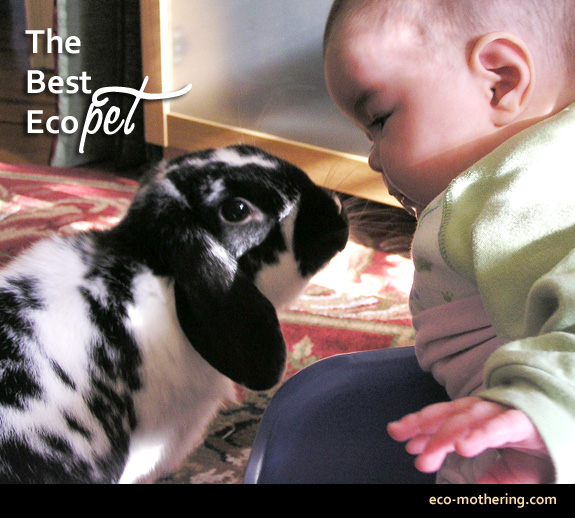
Sofie and Willow, an adopted Holland lop.
One study claims that owning a large dog is as ecologically harmful as driving an SUV. The main reason being the large amount of land given over to producing dog food. Research estimates about 1.1 hectares of land is used per year to create the chicken and grain ingredients. Cats get a bad rap for toxic litter boxes and their penchant for killing wildlife. According to Utne Reader, about 7.7 million cats in the United Kingdom kill more than 188 million wild animals every year.
Then there’s disposal of all that animal poop. Around 10 million tons of dog feces is produced by 73 million American dogs annually. Our country’s 90 million cats cause 2 millions tons of litter to be sent to landfills each year. And that litter is usually the non-biodegradable, clay-based kind that can only be produced by strip mining the earth. Cat poop also contains toxoplasma gondii, an organism that kills sea otters when people wrongly flush cat poop down the toilet.
Whew! Who knew cats and dogs were so loaded with eco-responsibility? One housepet, however, ranks pretty high on the scale of greenness: the bunny rabbit.
Here’s why:
- Since bunnies are vegetarians, you can grow their food (greens and herbs). Purchase timothy hay from local farmers. They can also weed your lawn, as rabbits love dandelions.
- Their poop does not contaminate waterways and acts as the perfect garden fertilizer.
- For litter boxes, you can use shredded recycled paper and toss it into the compost along with the bunny poop.
- Their favorite toys are things you’d often toss or recycle – cardboard toilet paper tubes, boxes, etc. Rabbits actually need to chew on such things to control their continuously growing teeth.
- Bunnies take up very little space and happily run around your house for exercise– no gas-guzzling trips to the dog park.
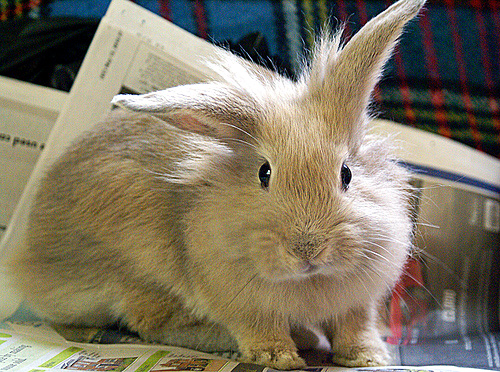
Bunnies love earth-friendly cardboard and newspaper. Cupcake by antaean
I can tell you from experience, this is pretty much true. Our bunnies ate hay and vegetables, and they pooped in litter boxes filled with biodegradeable wood stove pellets. (A great litter idea – the pellets soak up the urine and keep down the odor.) Before we had a compost pile, we had a friend who came over and eagerly collected our bunny poop to enrich her garden.

My husband and I never thought about sustainability when we acquired our first acquired bunny, but I am pleased to see how this eco-pet complements our lives. This information may change our desire for a dog. (I have yet to research horses.)
If you do decide to add a bunny to your family, don’t buy one from a pet store. Pet stores often get the runts of the litter and offer an environment that is stressful to these sensitive creatures. Adopt one from your local animal shelter or House Rabbit Society.
If you are definitely a cat or dog person, you can adjust to more eco-friendly options.
This post is featured at Small Footprint Fridays.























All these three animal are very favorite of every people. Some people are also taking one of them and breed them well, its their passion. Dog is also my favorite one.
I have a house bunny and I have just been telling everyone what a great pet he is - for all of these reasons. He even “earns his keep” by providing that wonderful time release fertilizer and the liquid gopher repellent! He runs freely in the bedroom when we’re out and about the whole house when were home. I can’t imagine keeping him in a cage! He does like to chew cords, so all of our [new] laptop cords have fleece cozy covers that I sewed for them
Our first bunny had free roam over the house. She’d lie outside our bedroom door in the morning until we woke up.
I love having bunnies, but I have never let them run loose because they pooped/peed everywhere when I did. Can they be litter trained like a cat?
Jill, bunnies can be litter trained like cats. Definitely for the pee. We’ve had varying levels of success with bunny poop depending on our rabbits.
Oh I just love bunnies! It’s too bad that my oldest is terribly allergic